Shopify Markets vs expansion stores: an honest comparison for growing brands
By Joe Tuckwell
30th July 2026


For years, Shopify expansion stores were the standard way to sell internationally. If you wanted dedicated storefronts for the UK, US, Australia and Europe, the usual approach was to create separate Shopify stores for each market.
Many successful ecommerce brands still operate this way today and in some cases it's absolutely the right choice.
But Shopify Markets has changed what's possible. Businesses that once needed multiple stores can now manage international selling from a single Shopify setup, with local currencies, languages and customer experiences all handled within one platform.
That doesn't mean expansion stores are no longer an option and everybody should rush to Shopify Markets. The reality is that both approaches have strengths and limitations. The right choice depends on your products, operations, growth plans and SEO strategy.
In this guide, we'll look at the genuine trade-offs between Shopify Markets and expansion stores in 2026, so you can make an informed decision based on your business rather than industry hype.
What are Shopify expansion stores?
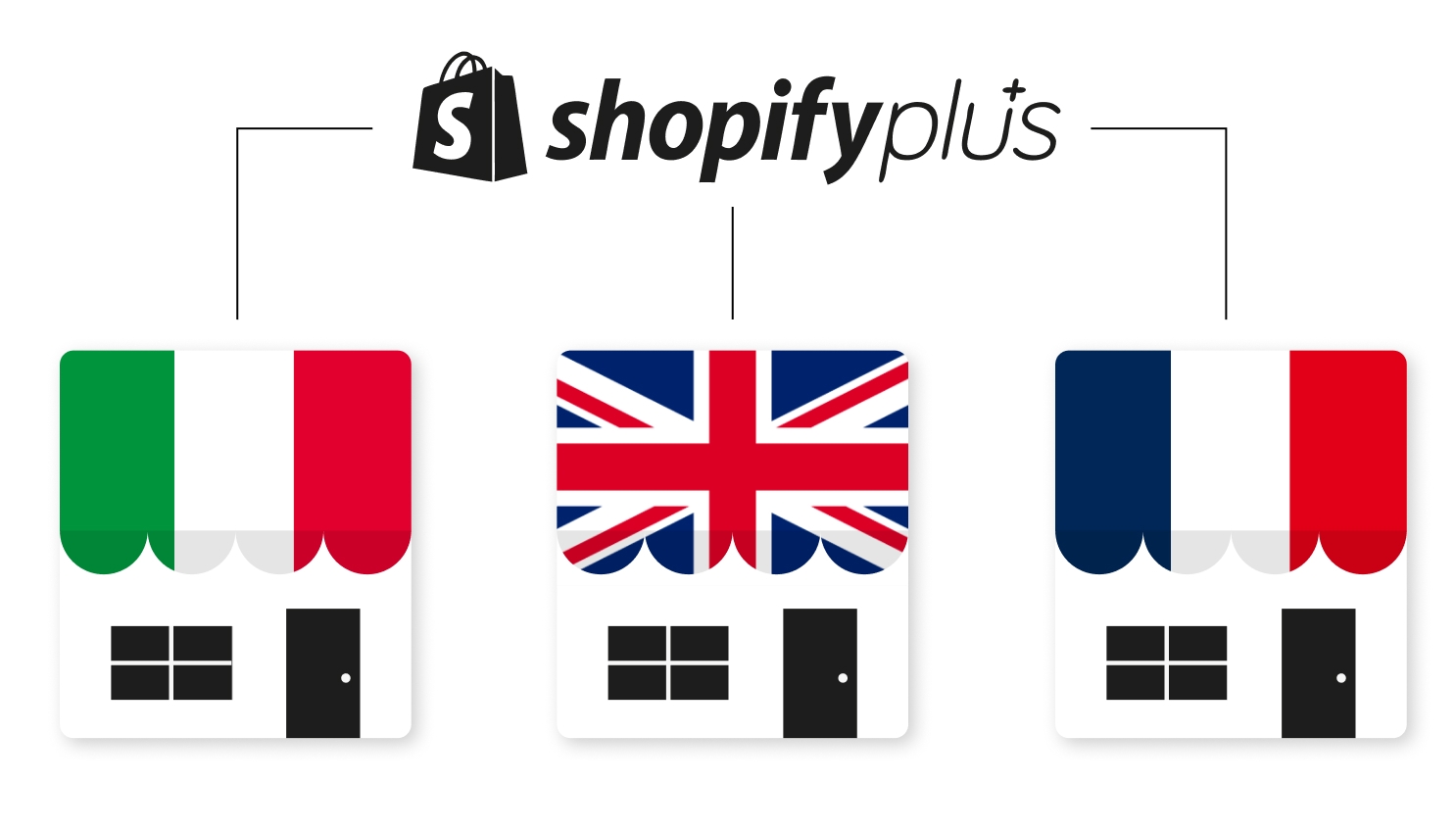
A Shopify expansion store is a separate Shopify store created for a specific country or region.
For example, a brand might operate stores in the UK, US and Australia. Each one has its own Shopify admin, theme, product catalogue, apps and subscription.
Before Shopify Markets launched, this was really the only practical way to create localised ecommerce experiences for different countries.
The advantage was flexibility. Each international storefront could be tailored to local customers, products and operational requirements.
The downside is that every store needs managing separately. Product updates, promotions, design changes and SEO work often need to be repeated across multiple stores, which can quickly become extremely time-consuming as you expand into more markets.
The case for Shopify Markets
If you’re launching your store internationally, Shopify Markets is likely to be the simplest place to start.
Instead of managing multiple stores, you can operate from a single admin and serve customers in different countries from one Shopify environment.
That means:
- One product catalogue to manage
- One theme codebase to maintain
- One set of inventory data
- One central place to run promotions and campaigns
For growing businesses, that simplicity can make a huge difference. If you update a product, launch a promotion or make a design change, you're typically doing it once rather than repeating the same task across several stores.
There are also significant SEO benefits. With Shopify Markets, international storefronts usually sit within subdirectories on the same domain, such as example.com/uk or example.com/us.
Because everything sits under a consolidated domain, all of your traffic, backlinks and SEO signals contribute to the same overall website authority.
Shopify also manages hreflang implementation automatically, helping search engines understand which version of a page should be shown in different countries.
For businesses entering international markets for the first time, this combination of operational simplicity and SEO consolidation is often hard to ignore. Our guide to setting up your first market walks through the practical steps.
And if you're new to the platform altogether, get the lowdown on what Shopify Markets is before deciding on your international structure.
The case for keeping expansion stores
While Shopify Markets offers plenty of advantages, there are still situations where expansion stores make perfect sense. One common example is when different regions sell genuinely different products.
Imagine you're selling skincare products in the UK, Europe and the Middle East. Regulations, ingredients and customer preferences may vary significantly from market to market. Managing separate product catalogues within dedicated stores can sometimes be simpler than trying to accommodate everything within one setup.
Brand positioning can be another factor. Some businesses market themselves differently in different regions, with distinct messaging, creative assets or customer journeys. In those cases, separate stores provide greater freedom and control.
Operational complexity also matters. If each market has its own fulfilment partners, customer service teams or ecommerce managers, separate expansion stores may work more naturally with how the business already operates.
There's an important SEO consideration too.
Many established brands have spent years building visibility on country-specific domains, known as ccTLDs, such as: example.co.uk, example.fr and example.de.
Those domains may have strong backlink profiles, established rankings and valuable link equity. Consolidating everything into a single domain isn't impossible, but it does introduce an element of risk that needs careful consideration.
For businesses with significant regional SEO assets, keeping expansion stores may still be the most sensible option...
The SEO argument for consolidation
… Having said that, if there's one area where Shopify Markets has a particularly strong case, it's SEO.
The challenge with expansion stores is that your website authority becomes split across multiple domains.
If your UK store earns a backlink from a major publication, that helps your UK site become more authoritative in Google's eyes. But your US store doesn't benefit from that backlink at all. The same applies in reverse.
Over time, each store has to build its own reputation, authority and backlink profile independently. This is often referred to as authority fragmentation. In practice that means you're spreading your SEO efforts across several websites instead of strengthening one. That can make growth harder than it needs to be, particularly if you’re in a competitive search market.
When you use Shopify Markets, all your stores contribute towards the same domain authority because they're housed within subdirectories on a single root domain. Every backlink, mention and piece of content helps strengthen the consolidated domain, which can benefit all markets over time.
For businesses investing heavily in SEO, that's often one of the strongest arguments for choosing Markets over multiple expansion stores.
If SEO growth is high on your list of priorities, read our article on how Shopify SEO and domain authority work together, to help you make a more informed decision.
Cost comparison: markets vs expansion stores
Cost shouldn't be the only factor in your decision, but it's difficult to ignore.
With Shopify Markets, merchants typically manage:
- One Shopify subscription
- One theme licence
- One core app ecosystem
- One development environment
With expansion stores, those costs are often multiplied across every region. That may mean:
- Multiple Shopify subscriptions
- Multiple theme licences
- Duplicate app subscriptions
- Additional development and maintenance work
Exact costs will vary depending on your setup, so it's always worth checking Shopify's current pricing rather than relying on fixed figures.
However, for most businesses, Shopify Markets results in significantly lower ongoing costs and less administrative overheads. The more markets you operate, the more noticeable those savings often become.

Migration risk: what to consider before consolidating
If you're currently running expansion stores and considering a move to Shopify Markets, it's worth going in with your eyes open.
Consolidation can simplify day-to-day management, but it also introduces migration risks, particularly from an SEO perspective.
When separate regional websites are consolidated, many of the URLs change. To help search engines understand where pages have moved, every old URL needs to be carefully redirected to its new location using 301 redirects.
This helps preserve as much of your existing SEO performance as possible. Done well, it enables search engines to understand where content has moved. Done poorly, it can lead to traffic losses, ranking drops and indexing issues.
Businesses should also be realistic about existing domain equity. If you've spent years building backlinks and rankings on a ccTLD, some risk comes with consolidation. Even with excellent redirect mapping, migrations can temporarily affect performance while search engines process the changes.
That's why a successful SEO migration requires careful planning, testing and monitoring. Before making any decision, it's worth evaluating:
- Existing domain authority
- Current backlink profile strength
- Organic traffic by market
- Redirect requirements
- Internal resources available for the migration
For many businesses, this is the point they turn to specialist support, like us at MoreSoda 👋. We've helped brands plan and manage complex Shopify migrations while protecting the search rankings they've worked hard to build.
So which should you choose?
For many businesses launching international expansion in 2026, Shopify Markets will be the right starting point. If you’re still unsure, run through the frameworks below to see which path suits your business best.
Choose Shopify Markets if:
- You're expanding internationally for the first time
- You operate in fewer than three markets
- You want a single manageable admin
- Your product catalogue is broadly similar across regions
- You want to consolidate SEO authority on one domain
Consider keeping expansion stores if:
- You have strong existing SEO visibility on ccTLD domains
- Product catalogues vary significantly by market
- Brand positioning differs by region
- Regional operations are managed independently
- Migration risk outweighs the potential benefits
Every business is different so there’s no universal right answer. Shopify Markets is often the simpler, more scalable option for growing brands. But expansion stores still have a place, particularly for businesses with complex operational requirements or established regional SEO assets.
We've helped merchants both launch new Shopify Markets setups and assess the risks of consolidating existing expansion stores. If you're weighing up the options, we can help you understand the SEO implications, operational considerations and migration challenges before you make a decision. Get in touch for a chat.
A quick recap before you go
There's no one-size-fits-all answer when it comes to international store structures, but hopefully this guide has helped clarify the pros and cons of each approach. To finish, let's tackle a few questions we hear regularly from merchants considering Shopify Markets or consolidation.
Should I migrate from expansion stores to Shopify Markets?
It depends on your situation. If you're starting international expansion, Shopify Markets is usually the better choice. If you already have established expansion stores with ccTLD domains, strong rankings and a valuable backlink profile, migration carries risk and should be planned carefully with comprehensive 301 redirect mapping.
Is Shopify Markets better for SEO than expansion stores?
For most merchants, yes. Shopify Markets keeps all markets under one root domain, meaning backlinks, link equity and domain authority support the entire website rather than being divided across separate stores.
Can I run Shopify Markets and expansion stores at the same time?
Technically, yes. However, it often creates unnecessary complexity. Running both simultaneously can lead to fragmented SEO authority, duplicate content concerns and operational confusion. For most businesses, it's not a recommended long-term strategy.